

A detailed guide to upgrading your hydroponic lighting with LED, HPS, and hybrid systems.
Lighting represents one of the largest capital investments for greenhouse and indoor grow operators and is arguably the most critical factor for optimizing plant growth, serving as both an energy source and a developmental signal. As LEDs become increasingly popular and high-efficiency HPS (high-pressure sodium) technologies evolve, many growers seek to upgrade their lighting systems to boost energy efficiency, yields, quality, and crop times. Hydrotek Hydroponics offers a range of solutions in LED and HID (HPS and CMH) technologies, providing comprehensive hybrid solutions to meet growers' specific goals.
Key Reasons to Retrofit:
- Enhance energy efficiency
- Lower electrical consumption and operating costs
- Replace outdated fixtures with discontinued parts
- Benefit from LED rebate programs
- Improve plant quality
- Boost yields
- Shorten crop times
- Increase light intensity
- Reduce maintenance requirements for lighting systems
- Improve light uniformity
- Enhance plant productivity and health
A prevalent retrofit trend is the replacement of legacy HPS luminaires with LED technologies. Many states and provinces currently offer rebate incentives for growers switching to LEDs, making it an opportune time for this upgrade. LEDs provide growers with greater control, as they possess a spectrum more efficient at converting photons into usable photosynthetic energy (photosynthetically active radiation or PAR). Additionally, LEDs are dimmable and have quicker start-up and power-down times than HPS luminaires, simplifying environmental management.
RETROFIT: HPS TO LED
When selecting LEDs for retrofitting, consider the spectrum required. Typically, there are two options: full/broad spectrum or red/blue spectrum. For indoor grows relying solely on artificial lighting, full-spectrum LEDs are usually the best choice.
Spectrum
Broad-spectrum LEDs offer a more complete light spectrum, including blue, green, yellow, orange, and red—similar to natural sunlight. They are also preferable for workers, as white light is easier to work under compared to blue/red light, enhancing plant assessment and general well-being. These LEDs are suitable for all growth stages, from vegetative to flowering.
Broad-spectrum LEDs can replace MH or CMH luminaires in the vegetative growth stages for crops like cannabis or leafy greens. Greenhouse growers of vine crops and ornamentals also use them for various production stages based on their needs.
Red and blue LEDs, which emit light that can appear pink or purple, are recommended for supplementary lighting in greenhouses where plants already receive full-spectrum sunlight. Since photosynthesis peaks in the blue and red spectrums, these LEDs are more efficient at converting photons into photosynthetic energy, thereby increasing overall energy efficiency.
Luminaire Design
When considering retrofitting, the design of the luminaire is crucial. LED luminaires come in various shapes, sizes, and lengths, depending on their intended application. For example, greenhouse applications often use linear luminaires to minimize crop shadowing, while other applications may require larger, rectangular luminaires for higher light output. The optimal form factor for your application will depend on whether your facility is a greenhouse or sole-source application, the mounting height of the luminaires, and the required light intensity.
A critical design aspect to consider when purchasing an LED system is its thermal design and engineering. Some companies use water or fans to cool their LEDs, which can be expensive to operate and may cause issues such as corrosion and biological growth build-up, leading to higher failure rates. Excessive heat can also lead to catastrophic LED failure, necessitating the replacement of the entire luminaire. Hydrotek Hydroponics’ LED products are designed with passive conduction to dissipate heat away from the diodes and circuit boards, resulting in zero corrosion, higher efficiencies, and longer lifespans.
Multi-bar LED luminaires, typically used in vertical racking systems for source applications, have a slim design ideal for close-to-crop spacing and propagation cycles. These units are also suitable for replacing MH and CMH luminaires traditionally used in vertical or indoor grow operations, providing broad-spectrum light with higher blue content.
Light Output and Uniformity
HPS luminaires use special reflectors to distribute light widely over the crop surface, with crossover light achieving fewer luminaires and higher uniformity. In contrast, LEDs deliver more directionally focused light unless designed with optics to distribute light evenly. In scenarios with limited mounting heights, a wider light distribution is beneficial. Achieving the same PPFD with LEDs as with HPS may require 2-3 LED luminaires for each HPS luminaire to maintain uniformity.
It is advisable to have a professional lighting company create a customized light plan to optimize luminaire placement for maximum uniformity.
Depending on your building design, additional tracks may be needed to hang LED luminaires for uniform light distribution over the crop. A customized light plan will ensure optimal uniformity. The distance from luminaire to crop canopy should also be considered when switching to LEDs.
Installation
Since LEDs operate at cooler temperatures than HPS lights, watering adjustments may be necessary due to differences in transpiration and water uptake. Water usage typically decreases, but this varies depending on the crop and growing environment. Nutrient management may also be impacted by the switch in lighting technologies.
LEDs have the advantage over HPS in converting more photons into PAR light energy for photosynthesis. HPS luminaires can achieve up to 2.1 umol/J with our NXT2, but LEDs are generally more efficient, often exceeding 3 umol/J. This increased efficiency allows for a reduced energy load while achieving higher levels of photosynthetic light.
Watering & Nutrient Uptake
LEDs provide lower operating temperatures compared to traditional lighting, maintaining equal or better light intensity than HPS luminaires. They dissipate heat through convection, moving it away from the crop, unlike HPS lighting, which directs heat towards the crop. This can be advantageous for crops requiring cooler temperatures, such as lettuce, strawberries, and leafy greens. For indoor grows, LEDs reduce HVAC load by generating less heat.
All luminaires generate heat, but in different ways. LEDs emit mainly convective heat upwards, resulting in lower ambient temperatures, while HPS luminaires emit more radiant or infrared heat, converting more light into heat than PAR energy. Heat-loving crops like tomatoes, cannabis, and ornamentals benefit from the radiant heat of HPS luminaires for growth and development, so growers may need to adjust their environment when switching to LEDs.
Even if light levels remain consistent with LEDs, plants cannot use all the light for growth unless grown under the same temperature as older HPS lights. The law of limiting factors in plant cultivation—light, CO2, and temperature—must remain balanced for optimal crop growth. Imbalances can compromise productivity, yield, and quality.
Heat Dissipation
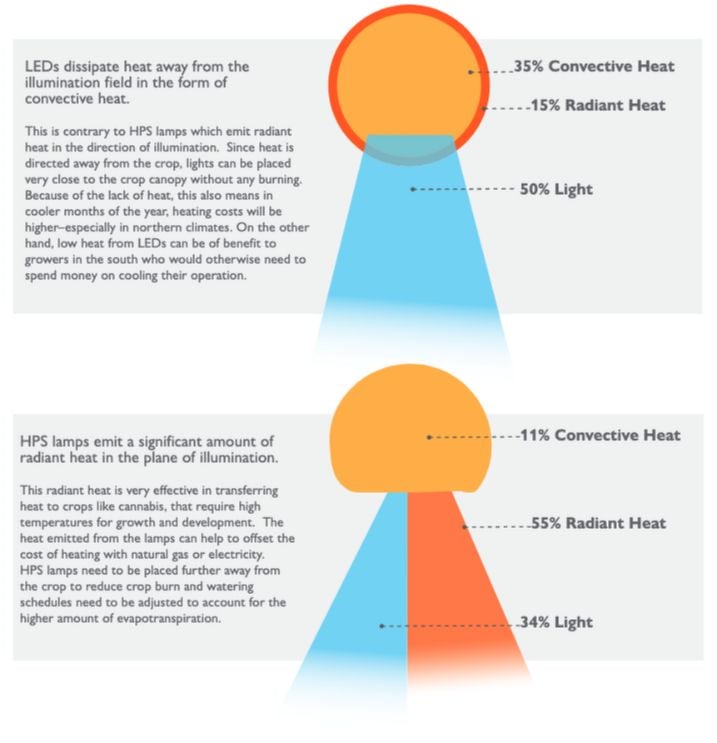
LEDs dissipate heat away from the illumination field as convective heat, unlike HPS lamps which emit radiant heat towards the crop. This allows LEDs to be placed closer to the crop canopy without burning, reducing heating costs in cooler months. In southern regions, the lower heat from LEDs can reduce cooling expenses.
A recent study by Wageningen University found that while LEDs reduce electricity costs by 40%, they increase heating costs by 25%, resulting in total energy savings of 15%. Therefore, understanding the true energy savings of LEDs requires considering the entire energy picture and other energy usage areas affected by lighting technology switches.
RETROFIT: HYBRID LED-HPS LIGHTING SYSTEM
For growers undecided between LED and HPS, hybrid lighting offers a popular solution. An LED-HPS system allows growers to retain existing infrastructure, including HPS luminaires, while adding LEDs to existing tracks/trusses. Hybrid systems are versatile, suitable for various crops like vine crops, cannabis, leafy greens, and ornamentals, in both greenhouse and indoor applications.
Key Benefits:
- Utilize HPS radiant heat in winter, extend lighting season with LEDs (producing less heat)
- Lower costs by maintaining existing infrastructure and mitigating high capex of all-LED solutions
- Qualify for LED rebates
- Lower energy load compared to all HID installation
- Benefit from both diffuse and directional light
- Better spectrum control by combining technologies
- Improved light intensity control
- Balanced PAR wavelengths for plant growth
- Reduced electrical consumption compared to all-HID systems
- Energy Savings and Costs
One downside of LEDs for some growers is the lack of radiant heat, necessitating additional heating in a full LED system. HPS luminaires can offset heating costs in northern regions, making hybrid systems advantageous for balancing the environment and reducing heating costs in winter. HPS luminaires also improve crop leaf surface temperature.
The primary motivation for adopting LEDs is energy cost savings, as HPS luminaires can use up to 40% more energy. Hybrid systems leverage LED energy savings to reduce total energy load and qualify for local energy rebate programs.
Light Efficiency
HPS luminaires predominantly emit red wavelengths, beneficial for flowering and fruiting growth stages. LEDs offer various spectral options, optimizing plant photosynthesis. Combining HPS and LEDs provides a balanced light spectrum, enhancing crop performance, yield, quality, and growth efficiency.
Environment
HPS luminaires are favored in northern climates for their radiant heat, promoting plant growth and development and offsetting winter heating costs. HPS luminaires also help manage crop humidity and transpiration.
Switching to LEDs may alter plant needs, reducing transpiration and requiring additional heat for consistent photosynthesis. Hybrid systems offer environmental control flexibility, allowing growers to use HPS and LED lighting as needed, such as turning off HPS in spring/fall to extend the growing season with LEDs.
Hybrid systems also accommodate growing various crop varieties, as some may be more sensitive to LEDs and perform better with a combination of HPS and LED lighting.
RETROFIT: LEGACY HPS (MAGNETIC BALLAST) TO ELECTRONIC BALLAST HPS
Upgrading from magnetic ballast HPS luminaires to electronic ballast HPS luminaires offers several benefits:
- Increased light levels
- Improved energy efficiency
- Fewer luminaires needed due to better reflector technology
- Faster start-up times
- Enhanced light quality
- Improved crop yields and quality
- Energy Efficiency
HPS luminaires have evolved over 40+ years and remain popular for their performance with crops like tomatoes, cucumbers, flowers, and cannabis. For growers seeking a lighting upgrade, electronic ballast HPS luminaires provide improved lighting technology benefits without fully switching to LEDs.
Installing Your Luminaires
Upgrading to newer HPS luminaires enhances light levels, increasing yields, quality, and reducing crop times. Newer HPS technologies deliver more light with fewer luminaires due to higher wattage, increased intensity, and improved reflector technology, eliminating the need for additional track/truss.
Improved Light Levels
Greenhouse growers rely on HPS radiant heat for plant growth and development during colder months. Upgrading to newer HPS luminaires maintains greenhouse climate consistency, eliminating the need for control, nutrient, and watering adjustments.
Replacement Parts & Maintenance
Finding replacement parts for legacy magnetic ballast HPS technologies is challenging, and they require more maintenance. Electronic ballasts simplify luminaire start-up, maintenance, and repairs, and compatible lamps are readily available. Hydrotek Hydroponics' systems are designed for easy maintenance, with reflectors that can be cleaned annually with a vinegar-water solution, unlike older technologies.
CONTACT US
Our sales team supports customers throughout their projects and beyond. Contact your regional sales manager to learn how Hydrotek Hydroponics can assist with your growth needs.
Our North American-based customer service team is available Monday – Friday from 8:00 am to 4:30 pm (EST) for product-specific inquiries and technical guidance, ensuring a seamless experience.
Our website provides 24/7 access to product information.
